CQC accredited on line interactive healthcare training courses aimed at private healthcare professionals and organisations.
What makes someone to consider a career in social care? For many people, it might just be having the opportunity to see what working in care is really like. In a recent BBC Radio 4 interview, Paul Sager raised an interesting idea for discussion. Based on his own experience of receiving care, Paul suggests that,…
For laser, beauty and skin clinics, delivering effective treatments is only one part of providing a professional service. It is just as important that team members understand laser and IPL safety, hazards and their responsibilities when working with optical radiation equipment. Core of Knowledge training provides an understanding of laser principles and safety, giving learners…
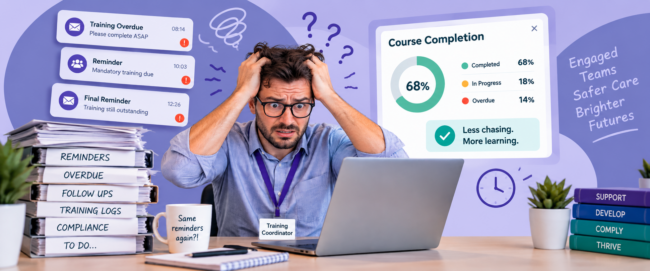
It is essential to keep staff training up to date in health and social care, but getting everyone to complete their courses on time often becomes an bit of a headache. In an ideal world, managers would not have to spend hours checking spreadsheets, sending emails and reminding employees about overdue mandatory training. Organisations can…
ADHD in health, social care and education is becoming more important for professionals who support children and adults. Attention Deficit Hyperactivity Disorder (ADHD) is a neurodevelopmental condition that can affect attention, impulsivity, activity levels, organisation and emotional regulation. For staff working in healthcare, social care and education, understanding ADHD helps to create a more inclusive…
When a child or young person is distressed, knowing what to say or do can often be challenging. They may be frightened, withdrawn, tearful, angry or just behaving differently from usual. For professionals working with children and young people, knowing how to respond calmly and appropriately can make all the difference to the child. Psychological…
Online Healthcare Training: 5 Key Benefits – It’s often hard to find the time for staff training in a busy health or social care environment. With staffing levels, changing shifts and the everyday responsibility of supporting patients and service users it is often a balancing act. Online healthcare training is a practical way for organisations…
Care workers are often first in recognising and responding to hate crime when someone is being targeted just because of who they are. Hate crime can damage a person’s physical health, confidence, independence and willingness to access services. Understanding hate crime in health and social care is an important part of safeguarding and delivering compassionate,…
Patient safety depends on the checks, staff decisions and conversations made during every working day. Whether care is being given in a hospital, clinic, care home or in a community setting, healthcare staff have the important role of helping to identify risks and prevent avoidable harm. The World Health Organization states that around one in…
The inspector has arrived. A manager is asked to show evidence that every employee has completed the organisation’s mandatory care training. The request sounds pretty straightforward—until the search begins. Some certificates are stored in personnel files. Others are attachments on emails. In places dates on the training spreadsheet don’t match the learning management system, and…
Over several months a care worker has built a trusting relationship with a service user they support. One afternoon, the individual gives them an expensive gift as a thank-you for all their help. Refusing feels unkind, but accepting it definitely does not feel appropriate. What should the care worker do in this awkward situation? This…