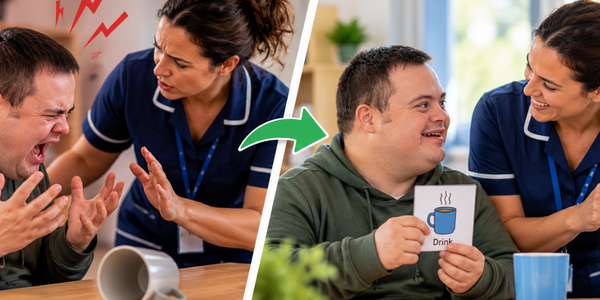
When someone displays behaviour that challenges, our first instinct is often just to focus on stopping it. But what if that behaviour is actually communicating something important?
Positive Behaviour Support (PBS) encourages health and social care professionals and educators to look beyond the behaviour. We should try to understand its underlying causes and provide support that helps to improve an individual’s quality of life.
Whether working in a care home, supported living environment or classroom, understanding PBS can make a real difference to the people receiving support.
What Is Positive Behaviour Support?
Positive Behaviour Support is an evidence-informed, person-centred approach that focuses on understanding why challenging behaviour occurs and creating environments that promote wellbeing, independence and positive experiences.
PBS uses proactive strategies to identify potential triggers, address unmet needs and develop alternative ways for individuals to communicate, rather than reacting negatively when difficulties arise.
Behaviours of concern are often a form of communication, particularly when someone finds it hard to share their needs verbally.
Why Is Positive Behaviour Support Important in Education, Health and Social Care?
In health and social care, behaviours that challenge often arise from anxiety, pain, frustration, sensory sensitivities or changes in routine. Without understanding these factors, staff may not understand and simply react to the behaviour rather than the underlying need, potentially increasing distress. For example, a person living in residential care becomes agitated during morning personal care. Staff might initially assume their reaction is refusal or non-compliance.
However, observation may reveal that the person feels overwhelmed by unfamiliar staff, changed or rushed routines or feels they have no choice. By introducing familiar carers, explaining each step and giving the person more time, the situation may become much less distressing.
This illustrates the basic principle of person-centred Positive Behaviour Support:
Changing the support provided can be more effective than trying to change the individual.
When done right, PBS can help:
- Reduce distress and the likelihood of behaviours escalating
- Promote dignity, independence and individual choice
- Reduce reliance on restrictive interventions
- Strengthen relationships between staff and the people they support
- Improve overall wellbeing and quality of life.
How Does Positive Behaviour Support Benefit Education Settings?
Positive Behaviour Support in schools and education settings can help teachers and support staff understand the needs behind behaviours that affect learning and participation.
A pupil who regularly walks out of the classroom may not just be skipping lessons. They could be experiencing sensory overload, anxiety or have difficulty understanding instructions. Being aware of these challenges allows educators to make adjustments, such as visual timetables, movement breaks, clearer communication or giving them access to a quieter space. Children and young people with special educational needs and disabilities (SEND) often find these approaches very helpful. PBS is not about removing expectations. It is about adapting the support given so individuals have more chance to succeed.
What Does NICE Guidance Say About Positive Behaviour Support?
The National Institute for Health and Care Excellence (NICE) provides excellent guidance on ways to support people with learning disabilities whose behaviour challenges.
NICE guideline NG11 emphasises understanding the function of behaviour, improving quality of life, adapting environments and using proactive support. Appropriate staff training, supervision and person-centred behaviour support planning is also recommended. Together, these principles make it clear why organisations should prioritise prevention, individual needs and dependable support, not just rely on reactive approaches.
Why Is Positive Behaviour Support Training Essential?
Even experienced professionals can find challenging behaviours hard to manage without the right skills and confidence. Positive Behaviour Support training helps staff develop a better understanding of behaviour, notice the early signs of distress and use a proactive approach in everyday situations.
Consistency across teams is also encouraged; this is very important when individuals are being supported by multiple professionals. Training is the foundation for safer, more compassionate practice but it does not replace individual assessment, specialist input or effective support planning,
Creating Better Outcomes Through Understanding
Positive Behaviour Support is about improving lives, not just managing behaviour. Understanding individual needs, recognising communication difficulties and making adjustments enable professionals to help create environments where people feel safer, respected and included.
For health and social care organisations as well as education providers, building PBS knowledge and encouraging staff development is an important step towards delivering more effective, person-centred support.
Explore Positive Behaviour Support training with Interactive Healthcare Training and discover how developing your team’s understanding can support more confident, compassionate practice.
Reference: The blog’s NICE section is based on NICE guideline NG11: Challenging behaviour and learning disabilities. This guidance specifically covers people with learning disabilities whose behaviour challenges, including relevant care and educational settings.