

The inspector has arrived.
A manager is asked to show evidence that every employee has completed the organisation’s mandatory care training. The request sounds pretty straightforward—until the search begins.
Some certificates are stored in personnel files. Others are attachments on emails. In places dates on the training spreadsheet don’t match the learning management system, and nobody can confirm if two night-shift employees completed their refresher training.
What should take minutes becomes a stressful and very time-consuming task.
It is a familiar scenario. Often showing that the problem is not the lack of training, but a failure to record, verify and monitor staff training.
Why are audit-ready training records important?
Audit-ready training records should be complete, accurate, current, accessible and evidence-supported.
This helps a care organisation demonstrate that employees have the knowledge, skills and competence they need to perform their roles safely. Reliable records allow managers to:
- Identify gaps in mandatory training
- Monitor course and certificate expiry dates
- Schedule refresher training before it gets overdue
- Confirm that learning is relevant to each employee’s role
- Give clear evidence during an audit or inspection
Incomplete records will make it difficult to demonstrate staff training compliance, even when staff have completed all the required training.
Poor record-keeping could also cover over more serious risks. An expired certificate, a new starter who has been overlooked or missing competency assessment could mean that a staff member is performing tasks with no up-to-date training or competence.
Here are seven warning signs that your care training records are not audit-ready.
1. Training records are being stored in different places
Some certificates are in paper files, others are saved in email accounts and the remaining information is split between spreadsheets and online learning platforms.
When there is no agreed system for information, records often become duplicated, inconsistent and difficult to find. This means managers will also struggle to produce a complete training history for a particular employee.
A centralised training record helps care organisations retrieve accurate evidence quickly during audits and inspections.
Have one central record showing each employee’s training status. Establish a consistent process for storing certificates, assessments, observations and competency sign-offs.
2. Records contain missing or unexplained information
Blank fields should never be overlooked.
A missing completion date, certificate, assessment result or staff signature might mean the training was completed but not recorded. It could also mean that the required learning never happened.
Both possibilities should be investigated.
Gaps in mandatory training records can prevent a care provider from demonstrating workforce compliance.
Regularly review gaps in records. Every missing item should have a status, a named person responsible for investigating it and a deadline for follow-up.
3. Refresher training is discovered only after it expires
If overdue training is coming to light by chance, the organisation’s monitoring process is reactive.
An audit-ready training management system should identify upcoming expiry dates early enough for refresher training to be assigned and completed. Automated alerts, monthly reports and traffic-light dashboards will help to manage this.
Care managers should monitor mandatory training expiry dates before refresher courses become overdue.
Set reminders in advance of deadlines. Upcoming expiries should be reviewed as part of routine management meetings rather than waiting until an audit is imminent.
4. Course descriptions are vague or inconsistent
Entries such as “online course completed” or “mandatory training done” provide little useful evidence.
A clear record should identify:
- The staff member’s name
- The title and subject of the training
- The completion date
- The learning method or training provider
- The assessment result
- The expiry or refresher date
- Assiciated competency assessments
Effective training records would show who completed the learning, what they completed, when it happened and when refresher training is due.
Use consistent course titles and recording standards so that other managers, auditors or inspectors can clearly understand what was completed.
5. Attendance is treated as proof of competence
Attending a training session does not prove that an employee would be able to apply the learning safely in practice.
For higher-risk or practical activities, the organisation may also need evidence of observation, supervision, assessment or a formal staff competency sign-off.
This is very important where employees perform practical tasks that require them to show safe techniques and good judgement.
A training certificate confirms course completion, but it does not always demonstrate practical competence.
Managers should define when a certificate provides sufficient evidence and when an additional competency assessment is required.
6. New starters work before their training records are complete
Operational pressure can lead to new employees appearing on the rota before their induction or mandatory training is fully completed.
Without a reliable way to check, an employee could be asked to perform certain duties before it is confirmed that they have completed the appropriate learning and assessments.
New care employees should complete role-appropriate induction and mandatory training before undertaking relevant duties unsupervised.
Introduce a pre-deployment checklist for all new starters. Record any temporary restrictions, supervision requirements or outstanding training clearly.
7. Nobody owns the accuracy of the training records
When everyone assumes that someone else is updating the system, errors happen quickly.
Your organisation should define:
- Who enters completed training records
- Who checks certificates and supporting evidence
- Who monitors certificate expiry dates
- Who follows staff up with overdue learning
- Who does internal record checks
- Who reports compliance gaps to senior management
Clear ownership is essential for accurate training record management and care sector audit preparation.
Assign responsibilities and conduct regular spot checks on the staff responsible. This keeps you audit-ready and in a proactive work routine instead of a last-minute search for evidence.
What should managers teach their teams?
Keeping accurate staff training records is not only an administrative responsibility. Every employee contributes to the quality of the compliance evidence.
Managers should train team members to:
- Understand which training is mandatory for their role
- Complete courses and refresher training within the correct timescales
- Submit certificates (and evidence) quickly
- Check that their personal training record is up to date and accurate
- Report any missing or wrong information.
- Understand that attendance, training and competence are not always the same
- Participate in practical assessments when needed
- Request help if they are not confident applying what they have learnt
Employees should understand why these records matter. Accurate training records help protect people receiving care, support staff to work safely and allow the organisation to demonstrate compliance.
How can you make sure training records are audit-ready?
To make training records audit-ready, care organisations should:
- Have a central source of accurate training information
- Record completion dates, assessment results and refresher deadlines
- Keep all relevant certificates and competency evidence
- Regularly check certificate expiry dates
- Investigate missing or inconsistent information
- Have designated staff monitoring records
- Conduct regular internal audits
Care organisations can make training records audit-ready by keeping complete and accessible evidence, monitoring refresher dates, checking competency where necessary and assigning clear responsibility for maintaining each record.
A small monthly review can help identify missing certificates, inconsistent dates and overdue actions before they become organisation-wide compliance problems.
Strengthen your approach to training compliance
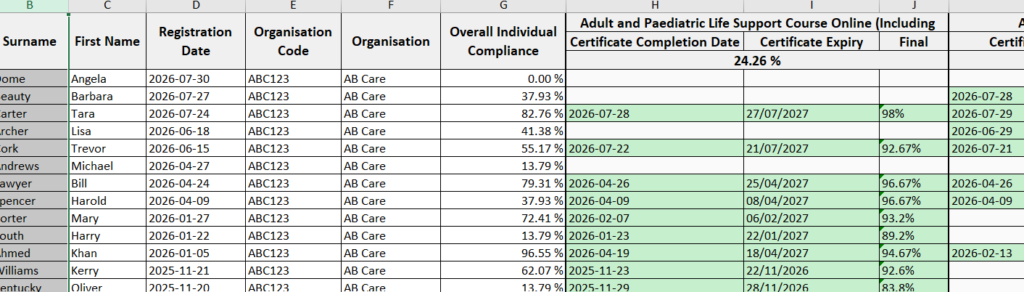
Our Training Records and Compliance portal enables managers to check on the progress of their staff’s training. You can also download the Compliance Report from the Client Portal for a real-time overview of your staff’s compliance.
Users can easily see their own compliance in the User Dashboard – courses have certificate expiry dates shown against them as well as many other features to help staff remain compliant.